Maa Baglamukhi Mantra
The traditional mool mantra of Maa Baglamukhi, with its meaning in English and Hindi, a word-by-word explanation, its devotional context, guidance on recitation, and how it relates to Mantra Jaap Seva.
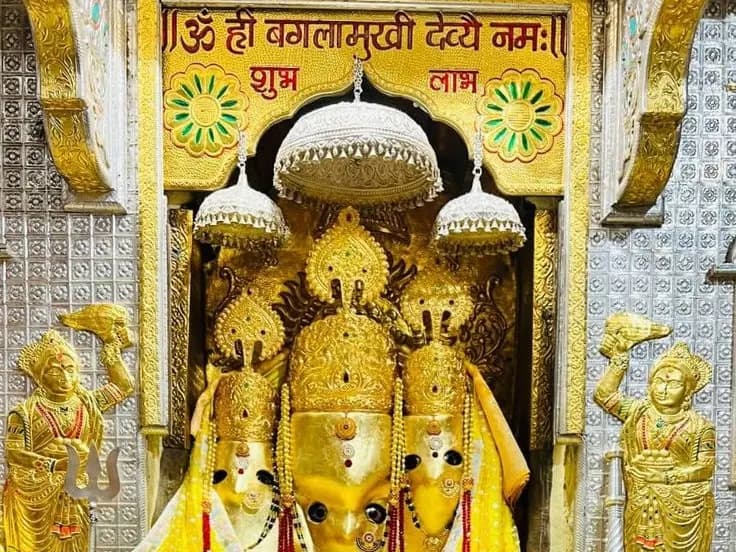
What Is the Maa Baglamukhi Mantra?
In Hindu devotional practice, a mantra is a sacred formula of sound through which a deity is invoked and worshipped. For Maa Baglamukhi — the eighth of the Dash Mahavidyas, also called Pitambara — the central one is her mool mantra, or root mantra. It addresses her directly and names the power she is known for: stambhana, the power to still or bring to a halt.
Within the mool mantra sits her beej mantra, the single seed syllable ह्लीं. The mool mantra is the complete prayer; the beej is regarded within the tradition as the deity's concentrated sound-form.
Because a mantra is recited exactly, its wording matters. Published versions sometimes differ by a syllable or in spelling, so this page gives one version only, as confirmed by Pandit Gajendra Vyas Ji.
Traditional Significance
According to traditional devotional practice, the Baglamukhi mantra is a prayer for steadiness and protection: for hostility, harsh speech and harmful intent to be stilled, and for the devotee to be granted clarity. Many devotees also read it inwardly, as a prayer to quiet their own anger, fear and confusion. These are matters of faith. The mantra is not presented here as having any proven or guaranteed effect — on disputes, finances, health or anything else.
The Mool Mantra
ॐ ह्लीं बगलामुखि सर्वदुष्टानां वाचं मुखं पदं स्तम्भय जिह्वां कीलय बुद्धिं विनाशय ह्लीं ॐ स्वाहा ॥
Meaning of the Maa Baglamukhi Mantra
“O Baglamukhi — still the speech, mouth and movement of all that is harmful; pin down its tongue and destroy its harmful intellect.” Within the tradition this is understood as a prayer for protection and for an end to hostility, not as a wish to harm any person.
शाब्दिक अर्थ: हे बगलामुखी! सभी दुष्टों की वाणी, मुख और पैरों (गति) को स्तम्भित करो, उनकी जिह्वा को कील दो और उनकी दुष्ट बुद्धि का नाश करो।
भावार्थ: हे दिव्य माँ बगलामुखी, स्वर्णिम बीज ‘ह्लीं’ से सुशोभित, हम आपकी शरण में हैं। समस्त नकारात्मक तत्वों की वाणी, गति व शत्रुतापूर्ण बुद्धि को स्तंभित करें; हमें मन की स्पष्टता व अटल सत्य प्रदान करें।
Both are explanations to aid understanding. They are not part of the original Sanskrit text.
Word-by-word explanation
| Term | Simple meaning | Traditional context |
|---|---|---|
| ॐ | Om | The sacred syllable with which Vedic and Tantric mantras traditionally open. |
| ह्लीं | Maa Baglamukhi's beej (seed syllable) | A beej is not translated; within the tradition it is treated as the deity's sound-form. It appears at both ends of this mantra. |
| बगलामुखि | “O Baglamukhi” | The mantra addresses the goddess directly. Explanations of the name itself vary between traditions. |
| सर्वदुष्टानां | “Of all the wicked” / “of all that is harmful” | Devotees often understand this to include inner negativity — anger, fear, confusion — not only other people. |
| वाचं मुखं पदं | “Speech, mouth (face), feet” | Together: expression and movement, the means through which harm is done. |
| स्तम्भय | “Still”, “bring to a halt” | From stambhana, the power with which Maa Baglamukhi is chiefly associated. |
| जिह्वां कीलय | “Pin down / bind the tongue” | Kīlana — “pinning” — is a ritual term for fixing or restraining. |
| बुद्धिं विनाशय | “Destroy the (harmful) intellect” | Traditionally read as ending harmful intent, not as a wish to harm a person. |
| स्वाहा | Closing word of offering | The word spoken as an offering is given, as in havan. |
Sanskrit words can carry more than one sense; these are common explanations, not the only ones.
Traditional Context of Learning and Reciting the Mantra
Devotees usually first meet this mantra in worship — in Maa Baglamukhi Puja, as the offering mantra of a havan, or at the heart of a multi-day Baglamukhi Anushthan. Some then take it up in personal recitation; others prepare for a formal jaap practice with a Sankalp and a count.
In each case the tradition places value on understanding the meaning before reciting, and on following the guidance of one's own tradition or teacher. Alongside the mantra, many devotees also read Maa's Chalisa or Kavach, and close their worship with the Aarti.
How Devotees Traditionally Approach Mantra Recitation
Understand the mantra
Know what you are reciting — the meaning and the word table above are a starting point.
Keep a respectful setting
A clean, quiet place of worship and an unhurried mind.
Follow your tradition
Many traditions hold that Mahavidya mantras are best taken up under a teacher, who also guides pronunciation.
Be consistent in jaap
If you undertake a jaap practice, keep to the schedule and count you began with.
Keep the intention clear
Formal jaap traditionally begins with a Sankalp stating its purpose and count.
These are common traditional considerations, not universal rules. This page does not prescribe a number of repetitions, a fast, a direction or a time — practices vary between traditions.
Personal Recitation vs Mantra Jaap Seva
Personal recitation
- You recite the mantra yourself
- Part of your own devotional practice
- On a schedule you manage
Mantra Jaap Seva
- Recited on your behalf by Pandit Gajendra Vyas Ji in Nalkheda
- Under a Sankalp taken in your name
- In an agreed count — 11,000, 21,000 or 31,000 — in Brahma Muhurat, on a haldi mala
Frequently Asked Questions
What is the Maa Baglamukhi Mantra?
It is the principal mantra used in the worship of Maa Baglamukhi, one of the ten Mahavidyas. It is recited in personal devotion, in her puja and havan, and in jaap.
What is the Baglamukhi Mool Mantra?
“Mool” means root: the mool mantra is the main, complete mantra of the deity. For Maa Baglamukhi it is ॐ ह्लीं बगलामुखि सर्वदुष्टानां वाचं मुखं पदं स्तम्भय जिह्वां कीलय बुद्धिं विनाशय ह्लीं ॐ स्वाहा.
What does the Baglamukhi Mantra mean?
It is a prayer to Maa Baglamukhi to bring all that is harmful to a standstill — its speech, its movement and its intent. Devotees traditionally take it as a prayer for protection and inner clarity.
Is the Baglamukhi Mantra available in Hindi?
The mantra is in Sanskrit and written in Devanagari, the script used for Hindi. This page gives a simple Hindi meaning (शाब्दिक अर्थ and भावार्थ) alongside the English explanation.
How should devotees traditionally approach mantra recitation?
With understanding, care and consistency, and under the guidance of one's own tradition or teacher. No single set of rules applies to every devotee.
What is the difference between personal recitation and Mantra Jaap Seva?
In personal recitation you chant the mantra yourself, at your own pace. In Mantra Jaap Seva, Pandit Gajendra Vyas Ji recites it on your behalf under a Sankalp, in an agreed count.
Can mantra jaap be performed on behalf of a devotee?
Yes. A Sankalp is taken in the devotee's name, and the jaap is offered for them — this is the basis of Mantra Jaap Seva.
How can I book Mantra Jaap Seva?
Through the Mantra Jaap Seva page, where you can contact Pandit Ji with your Sankalp details, choose a count and confirm a date.
Learn more about Pandit Gajendra Vyas Ji.
More Maa Baglamukhi Resources
- Maa Baglamukhi (माँ बगलामुखी)Who Maa Baglamukhi is, and the Nalkheda temple.
- Baglamukhi Chalisa (चालीसा)The devotional hymn of forty verses.
- Baglamukhi Aarti (आरती)The hymn sung while offering the lamp.
- Baglamukhi Kavach (कवच)The protective stotra in the kavach tradition.
- Baglamukhi Yantra (यंत्र)The sacred geometric form used in worship.