Shani, Rahu & Ketu Jaap in Nalkheda शनि, राहु व केतु जाप
A traditional Jyotish practice of mantra jaap for Shani, Rahu or Ketu, chosen from your kundli and performed on your behalf under a Sankalp by Pandit Gajendra Vyas Ji in Nalkheda.
- Shani 23,000
- Rahu 18,000
- Ketu 17,000
- Nalkheda, Madhya Pradesh
- Traditional Jaap Service
- Sankalp Guidance
- Direct Pandit Ji Contact

What Is Shani, Rahu & Ketu Jaap?
Jaap is the counted repetition of a mantra. In graha jaap, the mantra belongs to one of the nine grahas of Vedic astrology, and reciting it is a traditional way of offering worship to that graha.
Shani, Rahu and Ketu are each worshipped through their own mantra and their own count, because traditional Jyotish treats them as distinct grahas with distinct natures. For each, this service uses the graha's Vedic mantra and beej mantra.
The jaap is organised around the individual: Pandit Ji reviews your kundli, advises which graha's jaap applies, and takes the Sankalp in your name before recitation begins. It closes with a Dashansh Havan, daan-vidhan and the Aarti of Maa Baglamukhi.
Graha jaap is a religious and astrological practice. It is not a scientifically established treatment, and it does not guarantee any financial, career, health or other outcome.
Shani Jaap (शनि जाप)
23,000 jaapAccording to traditional Jyotish, Shani (Saturn) is the graha of karma, discipline, patience and time. It is regarded as slow-moving and exacting — the planet that, in the tradition's view, asks for steady effort and rewards it in time.
Some practitioners associate a difficult Shani placement or transit with periods that feel heavy or slow. Devotees may undertake Shani Jaap during such a period, or when their kundli is read as calling for it, to seek Shani Dev's favour and the patience to see the time through.
In this service, Shani's Vedic and beej mantra is recited 23,000 times under a Sankalp in your name, and the jaap concludes with Dashansh Havan, daan-vidhan and the Aarti of Maa Baglamukhi.
Shani Sade Sati and Dhaiya: Traditional Jyotish Context
- Sade Sati
- “Seven and a half”: the period of about seven and a half years during which Shani transits the sign before, the sign of and the sign after one's natal Moon.
- Dhaiya
- “Two and a half”: a period of about two and a half years during which Shani transits the 4th or 8th sign from the natal Moon.
Both are astrological concepts. How they are read for a particular person depends on the whole birth chart and the Jyotish method used, and being in Sade Sati or Dhaiya does not by itself mean that anyone needs jaap.
An individual's chart should be reviewed before selecting a specific remedy.
Rahu Jaap (राहु जाप)
18,000 jaapIn Vedic astrology, Rahu is a chhaya graha — a shadow planet, the north node of the Moon — with no physical body. It is traditionally associated with desire, ambition, the unconventional and the unexpected, and with confusion when it is considered afflicted.
Devotees may consider Rahu Jaap during a Rahu mahadasha or antardasha, or when a practitioner reads Rahu as troublesome in their chart, as a way of offering worship to the graha.
Rahu's Vedic and beej mantra is recited 18,000 times under your Sankalp, concluding with Dashansh Havan, daan-vidhan and the Aarti of Maa Baglamukhi.
Ketu Jaap (केतु जाप)
17,000 jaapKetu, the south node of the Moon, is Rahu's counterpart and also a shadow graha. Traditional Jyotish associates it with detachment, introspection and spirituality — and, when considered afflicted, with a sense of being unsettled or cut off.
Devotees may seek Ketu-related worship during a Ketu dasha or when their kundli is read as calling for it, often as much for its spiritual associations as for any concern.
Ketu's Vedic and beej mantra is recited 17,000 times under your Sankalp, with the same concluding Dashansh Havan, daan-vidhan and Aarti of Maa Baglamukhi.
Rahu Ketu Jaap
Rahu and Ketu are always opposite each other in the chart, so traditional Jyotish often reads them as a pair — for example in the configuration known as Kaal Sarp Yog, when all other grahas fall between them. Devotees may therefore consider Rahu and Ketu jaap together.
That is not always the case: one may be read as needing attention without the other. Whether to perform Rahu jaap, Ketu jaap or both depends on your horoscope and Pandit Ji's interpretation. For Kaal Sarp Dosh Nivaran itself, see Other Vedic Puja Seva.
What Is Graha Shanti?
Graha Shanti — “pacifying the planets” — is the traditional name for remedial worship directed at a graha that a practitioner reads as unfavourable in a chart. It is a remedial approach within Jyotish and Hindu ritual practice, and different practitioners prescribe different rituals for it. Common elements include:
Jaap
Counted mantra recitation
Puja
Worship of the graha or deity
Havan
Offerings into the sacred fire
Sankalp
The stated intention behind it
Daan
Traditional charity for the graha
None of these is ranked above another. Shani, Rahu & Ketu Jaap combines several of them: jaap, Sankalp, a concluding havan and daan.
Should I Perform Shani, Rahu or Ketu Jaap?
This page can't answer that for you. In traditional Jyotish, the choice depends on:
- Date of birth
- Time of birth
- Place of birth
- Your horoscope
- The specific concern
- The practitioner's interpretation
What Is Included in Shani, Rahu & Ketu Jaap Seva?
Kundli review
Pandit Ji reads the chart to decide which graha jaap applies.
Sankalp in your name
With your name, gotra and intention, for the selected graha.
Vedic and beej mantra jaap
Of the selected graha, in its prescribed count.
Dashansh Havan
A concluding havan after the jaap is complete.
Daan-vidhan
The traditional prescribed charity for the graha.
Aarti of Maa Baglamukhi
The jaap closes with Aarti of Maa Baglamukhi.
Pandit Ji's supervision
Pandit Ji performs the jaap and is reachable throughout.
On your behalf
No travel needed — the jaap is performed under your Sankalp.
Jaap Count
Shani Jaap (शनि)
23,000
Rahu Jaap (राहु)
18,000
Ketu Jaap (केतु)
17,000
Pandit Ji confirms the graha, count and start date with you. The Dashansh Havan, daan-vidhan and Aarti follow once the count is complete.
Shani, Rahu & Ketu Jaap Vidhi
- 01
Your details are collected
Name, gotra, city and birth details, along with the reason you are seeking jaap.
- 02
Horoscope discussion
Pandit Ji reviews your kundli and explains how traditional Jyotish reads the relevant grahas.
- 03
Graha selection
Pandit Ji advises whether Shani, Rahu or Ketu jaap — or more than one — applies.
- 04
Sankalp
The Sankalp is taken in your name for the selected graha and its count.
- 05
Mantra jaap
The graha's Vedic and beej mantra is recited until the prescribed count is complete.
- 06
Dashansh Havan
A concluding havan is performed once the jaap is finished.
- 07
Daan-vidhan and Aarti
Traditional daan for the graha is carried out, and the jaap closes with Aarti of Maa Baglamukhi.
- 08
Completion shared with you
Agree with Pandit Ji at booking how you'd like to be told — WhatsApp or a call — when it is complete.
What Information Is Required for Sankalp?
- Full name
- Of the person the jaap is for.
- Gotra, if known
- If you don't know it, Pandit Ji will guide you.
- Date of birth
- To cast the birth chart.
- Time of birth
- As exact as you can — it matters for the chart.
- Place of birth
- Town or city.
- Preferred date
- Pandit Ji confirms it after checking tithi and nakshatra.
- Purpose
- Your reason for seeking jaap, in your own words.
Why Horoscope Details May Be Requested
Traditional Jyotish practitioners use the date, time and place of birth to cast a birth chart, and interpret it before suggesting a graha-related ritual. Pandit Ji uses your kundli to decide which jaap, if any, applies.
Astrological interpretation varies by practitioner and tradition.
How to Prepare for Shani, Rahu & Ketu Jaap
- Information
- Have your birth details and Sankalp information ready when you contact Pandit Ji.
- Attendance
- Not required — the jaap is performed on your behalf in Nalkheda.
- Date
- Pandit Ji checks tithi and nakshatra before confirming the start date.
- Personal observances
- No fasting or clothing rule is listed for this service. If you'd like to observe something yourself, ask Pandit Ji.
Shani vs Rahu vs Ketu Jaap
| Aspect | Shani Jaap | Rahu Jaap | Ketu Jaap |
|---|---|---|---|
| Traditional Jyotish role | Karma, discipline, patience, time | Desire, ambition, the unconventional | Detachment, introspection, spirituality |
| Typical devotional context | Sade Sati, Dhaiya, or Shani read as afflicted | Rahu dasha, or Rahu read as afflicted | Ketu dasha, or Ketu read as afflicted |
| Jaap | 23,000 — Vedic and beej mantra | 18,000 — Vedic and beej mantra | 17,000 — Vedic and beej mantra |
| Concluding rites | Daan-vidhan and Aarti of Maa Baglamukhi | Daan-vidhan and Aarti of Maa Baglamukhi | Daan-vidhan and Aarti of Maa Baglamukhi |
| Havan | Dashansh Havan | Dashansh Havan | Dashansh Havan |
| Sankalp | In your name, for Shani | In your name, for Rahu | In your name, for Ketu |
| Booking | On its own or with others, as Pandit Ji advises | On its own or with Ketu, as advised | On its own or with Rahu, as advised |
This table is informational. No graha or jaap is considered more powerful or better than another.
Jaap vs Puja vs Havan
- Jaap
- Focused mantra recitation in a set count — as in this service or Mantra Jaap Seva.
- Puja
- Broader worship with invocation, offerings and Aarti — see Maa Baglamukhi Puja.
- Havan
- A fire ritual with ahutis — see Baglamukhi Havan.
Shani, Rahu & Ketu Jaap in Nalkheda
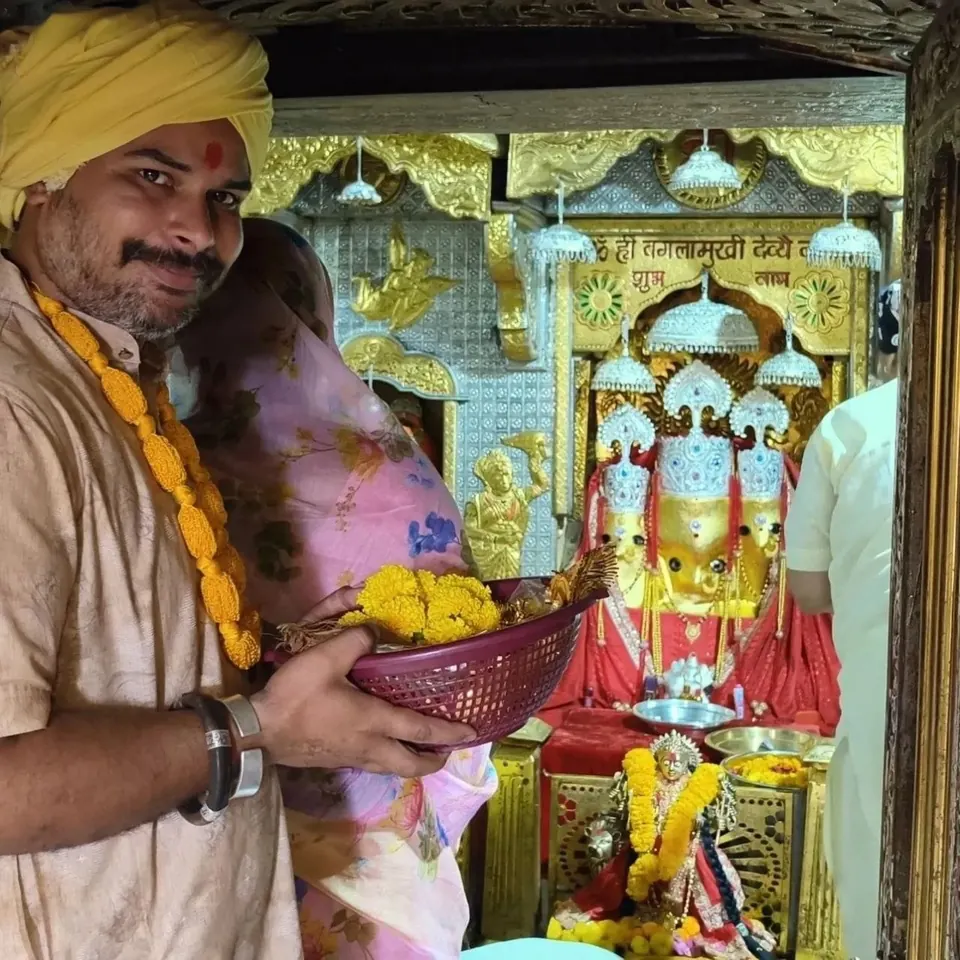
Pandit Gajendra Vyas Ji performs this jaap in Nalkheda, in the Agar Malwa district of Madhya Pradesh, where he serves devotees at Maa Baglamukhi Temple — which is why the jaap concludes with the Aarti of Maa Baglamukhi.
You don't need to be present: the jaap is performed on your behalf under your Sankalp. If you are visiting Nalkheda for darshan, you can meet Pandit Ji and discuss your kundli in person.
Meet Pandit Gajendra Vyas Ji
Pandit Gajendra Vyas Ji reviews each devotee's kundli himself before recommending a graha jaap, and then performs the jaap and its concluding rites. He studied karmakand in Vrindavan and Ujjain, received diksha in Ujjain, and is originally from Shajapur, Madhya Pradesh.
You speak with him directly about your chart, which jaap applies, the count, the date and the dakshina.
About Pandit Ji →
How to Book Shani, Rahu & Ketu Jaap
Contact Pandit Ji
By WhatsApp, a call or the booking form.
Share birth details
Date, time and place of birth, plus your Sankalp information.
Discuss the graha jaap
Pandit Ji reviews the kundli and advises which jaap applies.
Confirm count and date
Count, start date, procedure and dakshina are confirmed before booking is final.
Jaap is performed
By Pandit Ji in Nalkheda, under your Sankalp.
Receive completion information
Pandit Ji lets you know, as agreed, once the jaap and concluding rites are done.
Shani, Rahu & Ketu Jaap FAQ
What is Shani Jaap?
Recitation of Shani Dev's Vedic and beej mantra under a Sankalp. In this service the count is 23,000, followed by Dashansh Havan, daan-vidhan and the Aarti of Maa Baglamukhi. It is a traditional Jyotish practice, not a scientifically established remedy.
What is Rahu Jaap?
Recitation of Rahu's Vedic and beej mantra, 18,000 times, under a Sankalp, with the same concluding Dashansh Havan, daan-vidhan and Aarti.
What is Ketu Jaap?
Recitation of Ketu's Vedic and beej mantra, 17,000 times, under a Sankalp, with the same concluding Dashansh Havan, daan-vidhan and Aarti.
What is Shani Sade Sati?
In traditional Jyotish, Sade Sati is the roughly seven-and-a-half-year period when Shani transits the sign before, the sign of, and the sign after one's natal Moon. How it is interpreted for an individual depends on the whole chart and the practitioner's method.
What is Shani Dhaiya?
In traditional Jyotish, Dhaiya (or Dhaiyya) is a period of about two and a half years when Shani transits the 4th or 8th sign from the natal Moon. As with Sade Sati, its interpretation varies by chart and practitioner.
How is a suitable graha jaap traditionally selected?
From the birth chart. Pandit Ji reviews your kundli and advises which graha's jaap, if any, applies. This page cannot make that assessment for you.
Do I need to provide my birth details?
Yes. Date, time and place of birth (or an existing kundli) let Pandit Ji review the chart before recommending a jaap.
Do I need to visit Nalkheda personally?
No. The jaap is performed in Nalkheda on your behalf.
Can jaap be performed on my behalf?
Yes. The Sankalp is taken in your name and Pandit Ji performs the jaap and the concluding rites.
How can I book Shani, Rahu & Ketu Jaap?
Message Pandit Ji on WhatsApp (+91 9977537397) with your birth details and reason for seeking jaap, or use the booking form. He reviews the kundli and confirms the graha, count, date and dakshina before the booking is final.
Related Services
- Maa Baglamukhi Puja →Worship of Maa with Sankalp.
- Baglamukhi Havan →A fire ritual with the mool mantra.
- Baglamukhi Anushthan →A 3–11 day sadhana.
- Mantra Jaap Seva →Maa Baglamukhi's mantra, 11,000–31,000 jaap.
- Mangal Dosh & Ark Vivah Puja →Jyotish remedy for Mangal Dosh.
- Maa Baglamukhi Temple →Darshan and Aarti timings.
- Baglamukhi Mantra →Maa's mool mantra and its meaning.
॥ श्रद्धा • संकल्प • मार्गदर्शन ॥
Discuss Your Graha Jaap with Pandit Ji
Share your date, time and place of birth, a preferred date and your reason for seeking jaap. Pandit Ji will look at the chart and discuss the traditional ritual options with you. Available every day, 7:00 AM – 9:30 PM.